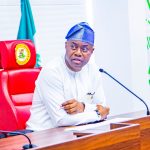
President Bola Tinubu has written to members of the House of Representatives, requesting approval for the implementation of new external borrowing contained in the 2026 Appropriations Act to the tune of about N10.8 trillion.
The borrowings, according to the President, are to implement the projects contained in the Appropriations Act to strengthen the macro gains made so far.
Tinubu had recently been under fire for increasing external borrowings, which critics said were capable of drowning the economy rather than rescuing it from the clutches of debts.
In response, Tinubu defended his administration’s plan to take more foreign loans, saying Nigeria needed long-term investment in infrastructure to achieve its ambition of becoming a $1 trillion economy by 2030.
His defense comes as the Nigeria Labour Congress (NLC) questions the government’s request to the National Assembly for approval to borrow $20.5 billion and €1.45 billion, despite claims that government revenue has increased following the removal of petrol subsidy.
In a statement titled From Reforms to Delivery: Our Infrastructure Investment and Growth Strategy, the President said the focus should be on what the borrowed money would achieve rather than how much the government was borrowing.
“The key question is not how much we borrow, but what we build, the value we create and the future we leave behind,” he said.
Tinubu listed the Lagos-Calabar Coastal Highway, Sokoto-Badagry Superhighway, Trans-Sahara Superhighway, electricity grid improvements and upgrades to major commercial ports in Lagos among the projects the government plans to fund.
He said the projects, alongside investments in healthcare, education and vocational training, would connect economic regions, reduce the cost of transporting goods, support farming and industries, and attract private investors.
The President said the Lagos-Calabar Coastal Highway alone could reduce transport costs along its route by 15 to 20 per cent and add up to two per cent to Nigeria’s Gross Domestic Product (GDP) through increased trade, tourism and industrial activities.
He projected that the highway would create about 100,000 direct jobs in construction and engineering, as well as more than 150,000 indirect jobs in logistics, building materials and related services.
“We are building more than highways. We are opening economic corridors, connecting markets, supporting industries and reshaping Nigeria’s economic geography,” he said.
Tinubu argued that Nigeria would need better infrastructure to achieve its target of a $1 trillion economy by 2030.
“We cannot build a $1 trillion economy with infrastructure designed for an economy a fraction of that size,” he added.