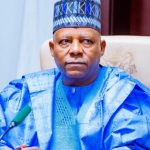


Vice President Kashim Shettima has tipped Nigeria to become number one hub of opportunities in the global halal economy.
He said the nation’s economic and demographic size puts it in a vantage position to map out a vibrant investment sector for the global halal economy projected to reach a market value of $7.7 trillion by 2025.
Shettima stated this on Wednesday, during the Halal Economy Stakeholders Engagement Programme held at the Banquet Hall of the Presidential Villa, Abuja.
He noted that Nigeria must first reassess its weaknesses and prioritise its strength to achieve this economic feat.
“For Nigeria to become a hub of opportunities in the global halal economy, we must prioritise our strengths and reassess our weaknesses. Today’s engagement provides a platform for us to collaborate with key international organisations.
“This will allow us to develop a comprehensive halal ecosystem and agree on strategies that will position Nigeria as a top halal exporter, targeting high-value markets,” he stated.
The vice president commended the private sector for its immense “contributions to driving the halal economy, particularly in the financial sector”, even as he encouraged all stakeholders to partner with the administration of President Bola Ahmed Tinubu in delivering the halal ecosystem.
“To ensure this, we must attract international investment by showcasing the vast opportunities within Nigeria’s halal sector through investor summits, roadshows, and business matchmaking events.
“The expansion of regional trade, particularly through the African Continental Free Trade Area (AfCFTA), also provides us with a pathway to become a leading supplier of halal goods and services across Africa
“Therefore, we must increase public awareness through strategic orientation campaigns, specialised training programmes, and deeper engagement with the global market to elevate the visibility and competitiveness of Nigeria’s halal ecosystem”, the vice president said.
Describing halal as an economy that accommodates all actors and stakeholders, the VP noted that the halal market holds vast potential that aligns “with the overarching agenda of His Excellency, President Bola Ahmed Tinubu.”
On why the nation will become a leading hub for investment in the halal economy, the vice president said, “Nigeria’s economic and demographic size gives us a unique advantage in developing a vibrant halal investment sector.
“With the global halal economy projected to reach a market value of $7.7 trillion by 2025, this opportunity is not only recognised by Muslim-majority countries but also seized by non-Muslim nations, which have become leading exporters of halal products. They understand that the halal ecosystem is designed to meet the highest standards of quality, safety, and sustainability preferred by specific consumers.
“This alignment with ethical principles and rigorous standards provides a compelling avenue for investment and commerce and reinforces our commitment to fostering a dynamic halal economy in Nigeria.”
The vice president further noted that the lack of clarity and understanding surrounding compliance with investments in the halal economy had stifled vast potential in savings, business ventures, and investments.
Senator Shettima, however, expressed delight that in an era of knowledge and enlightenment, more Nigerians are now getting rid of outdated concerns and are instead, embracing the need to have a say in how their money is invested.
He continued: “They seek secure products and services that align with the principles of transparency and ethical certainty, free from interest-driven practices. We must, however, note that Nigeria has already embraced the halal economy.
“We have flourishing financial institutions that offer profit-sharing and investment opportunities that resonate with the expectations of savers and investors, regardless of their faith. The remarkable success of Islamic finance instruments, such as Sukuk, which have funded infrastructure projects across the country, is a testament to the widespread appeal of halal finance.
“As Islamic banks continue to penetrate international markets, we are inspired to position ourselves as leaders in this growing sector, ensuring that Nigerians fully explore the opportunities it provides”.
Earlier, Deputy Chief of Staff to the President (Office of the Vice President), Sen. Ibrahim Hassan Hadejia, who emphasised the importance of this initiative, said, “Nigeria, as one of the largest economies in Africa, is launching this programme to engage with the global halal market. We are determined to position Nigeria as a leader in the halal economy, not just in Africa but globally.”
Also, Special Assistant to the President on Export Expansion, Aliyu Bunu Sheriff, highlighted halal economic potential, noting that “if we can increase our halal exports to the Organisation of Islamic Cooperation (OIC) countries from 2% to 6% over the next four years, it could boost our GDP by $548 million.”
Sheriff listed some of the key objectives of the initiative to include establishing a robust regulatory framework for halal certification, increasing consumer awareness about halal products, enhancing production capacity and partnering with international halal organisations.
Minister of Agriculture and Food Security, Sen. Abubakar Kyari, provided key statistics, saying, “Nigeria’s domestic spending on halal products and services reached approximately $107 billion in 2022.
“This sector is projected to grow at a rate of 10.7%, reaching $180 billion by 2027. This positions Nigeria as the 8th largest domestic halal economy globally and the second largest in Africa,” he added.
Minister of Finance and Coordinating Minister of the Economy, Wale Edun, said, “Halal products are not just for Muslims. There are over 125 products that are produced in the halal way. This presents a huge opportunity for rapid growth and improved competitiveness, enhancing our ability to export.”
He explained that the government is collaborating with international bodies such as the Islamic Development Bank (ISDB), Arab Bank for Economic Development in Africa (BADEA), and Halal Product Development Company, Saudi Arabia (HPDC) to ensure Nigerian halal products meet global standards.
In a keynote speech, the Secretary-General of the D-8 Organisation for Economic Cooperation, Ambassador Isiaka Abdulqadir Imam, emphasised the D-8’s economic significance based on its statistics, saying with a combined population of 1.16 billion people and a GDP of $4.92 trillion in 2023, the D-8 holds substantial economic potential.
He said the organisation of which Nigeria is a member has also advanced trade facilitation through the Preferential Trade Agreement and is working to boost intra-trade to $500 billion by 2030.
“To do that, one of our programmes is to deepen our trade in the halal industry and for this purpose we have established the D8 Comprehensive Strategy on Tourism and the Crescent Moon Initiative.
“Currently, the intra-trade among the D-8 members stands at US$146 billion. This does not reflect the true potential of a market with 1.16 billion people,” Imam said.