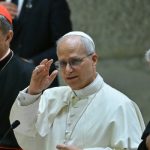


Thousands of worshippers lined the streets in Angola on Saturday to welcome Pope Leo XIV, who arrived in the country as part of his multi-nation African visit.
The pontiff’s stop in Angola follows earlier engagements in Cameroon, where he celebrated an open-air Mass at an airport in Yaounde before flying to the Angolan capital, Luanda. Billboards and banners bearing his image were mounted across the city ahead of his arrival, reflecting the excitement surrounding the visit.
Leo becomes the third pope to visit Angola, a nation where nearly half of the population identifies as Catholic. His itinerary includes meetings with President Joao Lourenco and several public religious events expected to draw tens of thousands of faithful.
Throughout the tour, the pope has repeatedly called for peace, condemned corruption, and warned against the exploitation of Africa’s resources. His remarks have grown sharper in recent days amid an ongoing exchange of words with Donald Trump over global conflicts. The situation escalated after U.S. Vice President JD Vance urged the Vatican to focus solely on moral issues.
Without naming individuals directly, Leo criticised leaders who misuse religion to justify violence and oppression. He also challenged African leaders to confront graft and ensure their countries’ wealth benefits their citizens.
These messages resonate strongly in Angola, a country still dealing with the legacy of a 27-year civil war that ended in 2002 and ongoing concerns over inequality and corruption, including scandals linked to the family of former president Jose Eduardo dos Santos.
The papal visit comes at a difficult time for many Angolans. Severe rainfall in the Benguela region has reportedly claimed dozens of lives this month. The country is also grappling with high living costs and the aftermath of recent protests that turned deadly.
Locals say they hope the pope will witness the realities faced by young people and families struggling with poverty despite Angola’s oil wealth.
On Sunday, Leo is scheduled to preside over a large outdoor Mass in Kilamba, where temporary facilities have been set up to host crowds. Later, he will travel by helicopter to Muxima, home to a historic church overlooking the Kwanza River and regarded as one of southern Africa’s key pilgrimage sites.
A new basilica under construction there is part of a broader effort to transform the area into a major religious tourism destination.
Before leaving Angola, the pope is expected to journey more than 800 kilometres to Saurimo to visit a retirement home and celebrate another Mass.
Angola is one stop in an extensive African trip that began in Algeria and will conclude in Equatorial Guinea. The 11-day tour spans thousands of kilometres and has drawn large crowds at every stage.
For many Angolans, the visit is seen as a rare and emotional moment, a sign of spiritual encouragement during challenging times and an opportunity for the global church leader to draw attention to the country’s social and economic struggles.