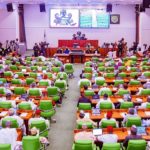


The Senate yesterday moved to impose a 10-year passport ban on Nigerians who have been convicted and deported from foreign countries over criminal activities.
This move followed the second reading of a Bill titled: “A Bill to amend the Passport (Miscellaneous Provisions) Act, Cap. P343 Laws of the Federation of Nigeria, 2004,” sponsored by Senator Bello Sani Abubakar (APC, Niger North).
Presenting the lead debate on the Bill on behalf of the sponsor, Senator Mohammed Ogoshi Onawo said the Bill was intended to highlight the need for more provisions in the extant legislation to globally preserve, sanctify, and redeem the image of the Federal Republic of Nigeria.
He said the Bill sought to provide for measures towards preserving the image of Nigerians while abroad and the Federal Republic of Nigeria.
“The implication of the proposed amendment is that where a Nigerian commits any of the foregoing offences in a foreign country and is convicted for the crime, the international passport of the convict would be withdrawn for 10 years. This measure serves as a veritable deterrent to the commission of crime in a foreign country.
“This proposed amendment will redeem, preserve, and elevate the image and integrity of our dear country. It is also an opportunity for us to demonstrate our commitment to good governance and stance against crimes and criminalities.”
In his lead debate, Onawo averred that the proposed amendment to the extant Act had become imperative and compelling as a veritable action to effectively redeem the severely tarnished image of Nigeria in the eyes of the international community.
The lawmaker said there was a need to enact a strong disincentive for the commission of crimes by Nigerians across international jurisdictions.
He said: “The commission of crimes by Nigerians in foreign jurisdictions has dealt a crashing blow to the reputation and image of Nigeria, and is costing us stupendous disgrace in the diplomatic community and in international transits.
“It projects Nigerians as personae non grata to whom foreign visas are restricted or denied, with a negative effect on our national interest.
“Countries like China, Turkey, Canada, France, Egypt, Germany, Ethiopia, South Africa, Russia, the United Arab Emirates, among others, which are destinations of interest to our citizens, apply stringent visa rules to Nigerians.
“A major reason for the visa restriction is the significant commission of crimes and conviction of Nigerians in those countries.
“Though profiles of crimes by Nigerians in foreign countries are protected for human rights reasons, as Chairman of the Senate Committee on Foreign Affairs, and being privy to the issues in the diplomatic community, the detriment of such crimes to our foreign affairs, the harm to our bilateral and multilateral interests, and the dent to our image and integrity, I am convinced, that it is incumbent upon us as a country to act and demonstrate responsibility to ending the indulgence of our citizens in crimes anywhere in the world.
“As a consequence of the injury to the integrity of our country from crimes by our citizens in foreign jurisdictions, innocent and patriotic Nigerians suffer harassment in international transits, denial and hardship in visa applications, discrimination and negative stereotype in social dealings, costs and distress.
“The green passport is widely discountenanced and the sovereign pride it intrinsically bears has severely diminished. That is nothing less than a state of emergency!
“The Legislature is mandated, under Section 4 of the Constitution, with lawmaking for the peace, order and good governance of Nigeria.
“The extant law on Passport (Miscellaneous Provisions) Act is good, but good is the enemy of better.
“It would do better if amended with provisions that impose an extra layer of deterrents to the commission of crime by our citizens in foreign countries.
“It would demonstrate responsibility on our part to discourage the perpetration of crime by our citizens and to redeem the image of our country.”
In their contribution, the senators supported the Bill and approved that it should be read for a second time when it was put to a voice vote by Senate President Godswill Akpabio.