

The US government has warned that foreign citizens who joke about or applaud the assassination of conservative activist Charlie Kirk risk losing their visas.
Kirk, 31, co-founder of Turning Point USA and a well-known commentator, was shot dead on Wednesday while delivering a lecture at Utah Valley University. His murder has provoked widespread outrage and intense online debates.
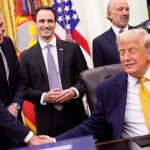
Deputy Secretary of State Christopher Landau said on Thursday that he had directed US consular officers worldwide to track and act on cases of foreigners glorifying the killing on social media. Writing on X, he called such behaviour “disgusting” and urged the public to flag offending posts. He also shared a meme with the caption “El Quitavisas” — Spanish for “The Visa Remover” — hinting at visa revocations.
Authorities later announced the arrest of the suspected gunman, 22-year-old Tyler Robinson from southern Utah, who allegedly confessed to a family member before being handed over to federal marshals by a minister close to him.
Former President Donald Trump confirmed Robinson’s arrest, saying the suspect had admitted to the crime before being escorted to a police station.
The killing has sparked condemnation across political lines while also raising questions about free expression, online moderation, and the extent to which foreigners should be penalised for celebrating violent acts.
Reports indicate that social media users flagged posts from Germany, Brazil, the United Kingdom, South Africa, and Latin America. Among those accused of mocking Kirk’s death are German satirist Sebastian Hotz, Brazilian media figures linked to Globo, Oxford Union’s incoming president George Abaraonye, and South African journalist Redi Tlhabi. Some were said to have made private jokes, while others allegedly described Kirk as an extremist or suggested other Republicans might be future targets.
The fallout also reached the US Navy, where Secretary John Phelan warned that service members and civilian employees would face swift punishment if they were found mocking Kirk’s murder. His remarks split opinion, with supporters saying military personnel represent the nation and should be held accountable, while critics argued they retain the right to comment on private citizens.
Kirk’s assassination has revived concerns about escalating political tensions, the spread of violent rhetoric online, and the international implications of digital commentary in a polarised era.